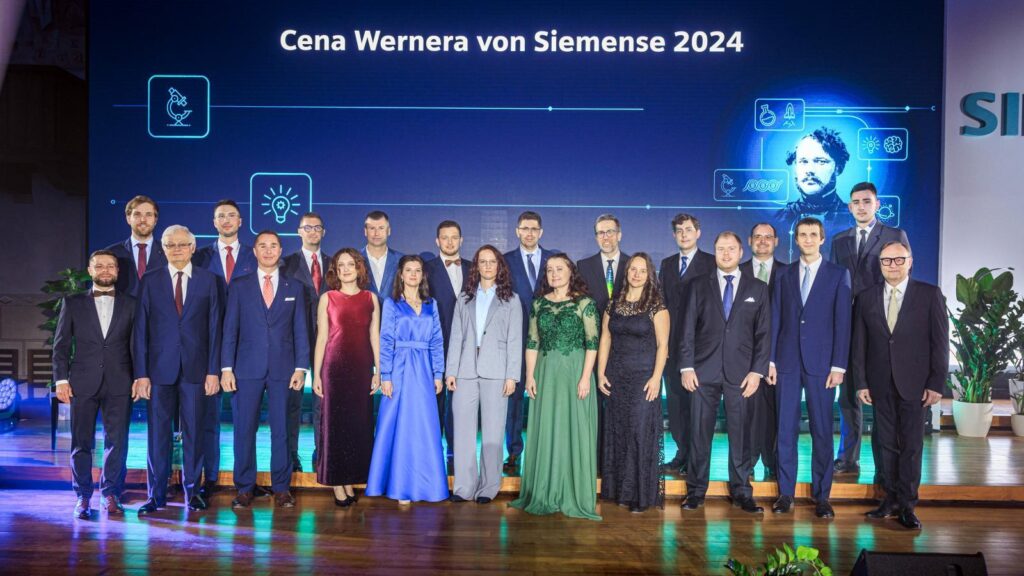
As the announcement of the Werner von Siemens Award 2025 approaches, we take a moment to look back at one specific highlight of the previous year, a truly exceptional one for RICAIP Testbed Prague. Two researchers connected with the Testbed, Marina Ionova and Ondřej Švec, were among the awardees in the Industry 4.0 category, confirming the strength of the Testbed environment in nurturing young talent and impactful research. Their success is not only a personal achievement but also a testament to the role of RICAIP Testbed Prague as a space where promising students can grow into confident researchers ready to contribute to industry and academia alike.
Marina Ionova: 1st Place (Industry 4.0)

Humans are flexible and make decisions on the fly, while robots are precise and consistent. The challenge is to combine these strengths so that both sides benefit.
Marina Ionova is a graduate of Cybernetics and Robotics at the Faculty of Electrical Engineering, Czech Technical University in Prague. She was part of RICAIP Testbed Prague between 2020 and 2024, where she worked as a junior researcher, and she currently works as a robotics engineer at Škoda Group, focusing on autonomous and safety systems for trams.
Marina received first place in the Industry 4.0 category for her diploma thesis “Uncertainty-Aware Human–Robot Collaboration Using Scheduling and Reactive Control”, supervised by Jan Kristof Behrens, MSc., PhD. (Faculty of Electrical Engineering, Czech Technical University in Prague) Her work addressed a key practical challenge in modern production: how to combine human adaptability with robotic precision during joint task execution.
Marina’s solution stands out through the integration of online planning and reactive robot control into a single system. Unlike traditional approaches based on fixed plans, her method explicitly works with uncertainty (such as variable task durations or unpredictable human decisions) making it highly relevant for modern, flexible manufacturing systems. The main technological challenge was bridging high-level planning with real-time robot behavior. Overcoming this gap became one of the key contributions of her work and a significant step toward more adaptive and resilient production lines.
Beyond its technical impact, the award also carried a strong personal meaning for Marina: “For me, receiving the Werner von Siemens Award was not only a personal achievement. I perceived it as recognition of women in technical fields and as a way to make our work more visible, especially for young women who should see that they belong in technology and research.”
Ondřej Švec: 2nd Place (Industry 4.0)
This approach significantly shortens the time needed for development, testing, and deployment, as much of the tuning can be done in a virtual environment without interfering with the physical production line.

Ondřej Švec is a researcher at the Czech Institute of Informatics, Robotics and Cybernetics (CIIRC) at CTU in Prague. His work focuses on digital models and simulation tools for robotic systems and their integration with real industrial environments.
Ondřej received second place in the Industry 4.0 category for his diploma thesis “Robotic Object Manipulation in Virtual and Physical Environment”, supervised by Tomáš Jochman (Czech Institute of Informatics, Robotics and Cybernetics, Czech Technical University in Prague). His research focused on integrating digital models and synthetic data generation using NVIDIA Omniverse to accelerate the development of robotic applications.
What makes Ondřej’s solution exceptional is the tight integration of virtual and physical systems into a single architecture. Unlike conventional workflows that separate simulation and real operation, his approach enables robot applications to be developed and optimized virtually and then transferred to real systems with minimal adjustments. This concept directly supports key Industry 4.0 needs – rapid reconfiguration, small-batch production, and high adaptability of robotic workplaces. The solution also holds strong potential for reducing integration costs and increasing system flexibility.
For Ondřej, the award confirmed the practical relevance of his research: “It validated both the professional quality and the industrial value of my work and strengthened my motivation to continue in this research direction.”
Shaping the Researchers of Tomorrow
The achievements of Marina and Ondřej highlight the unique environment that RICAIP Testbed Prague provides for its young researchers. It attracts talented students and graduates from the Faculty of Electrical Engineering (FEE CTU), the Faculty of Information Technology (FIT CTU), and the Faculty of Mechanical Engineering (FME CTU) at Czech Technical University in Prague. Here, they tackle challenging research problems, work with cutting-edge equipment, and contribute to projects that are often closely connected to real industrial needs. This hands-on engagement allows them to turn academic knowledge into practical solutions while gaining valuable experience that prepares them for successful careers in both industry and academia.
By combining state-of-the-art infrastructure, hands-on industrial challenges, and access to top academic guidance, the Testbed enables students and early-career researchers to transform their potential into tangible results. It is a place where curiosity meets opportunity, and where innovative solutions to real-world problems can emerge. As Pavel Burget, Director of RICAIP Testbed Prague, emphasizes:
RICAIP Testbed Prague is not just a research facility, it is a seedbed of great people and ideas. We are able to identify talent already during their studies, prepare them for professional life at the university, and provide them with a high-quality environment for further development. We support their growth, react flexibly to their needs, and help them mature into independent researchers. Our goal is not only to keep them with us but also to send them into the world well equipped for their future careers.