
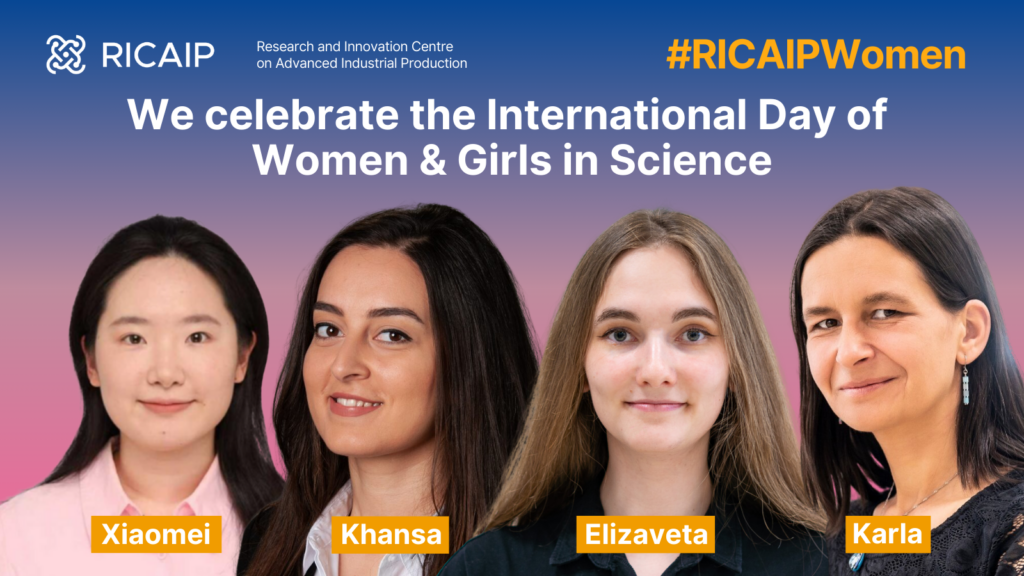
At RICAIP, we’re proud to celebrate the International Day of Women and Girls in Science, recognized by the United Nations on February 11. Science thrives on diverse perspectives, and we’re lucky to have talented women in our teams contributing to exciting research and innovation. This year, we’re introducing three inspiring researchers, each with a unique story and expertise. Whether they are part of our teams, involved in synergistic projects, or directly engaged in RICAIP initiatives, their stories deserve to be heard. Get to know Khansa and Xiaomei from ZeMA, and Karla and Elizaveta from CIIRC CTU.
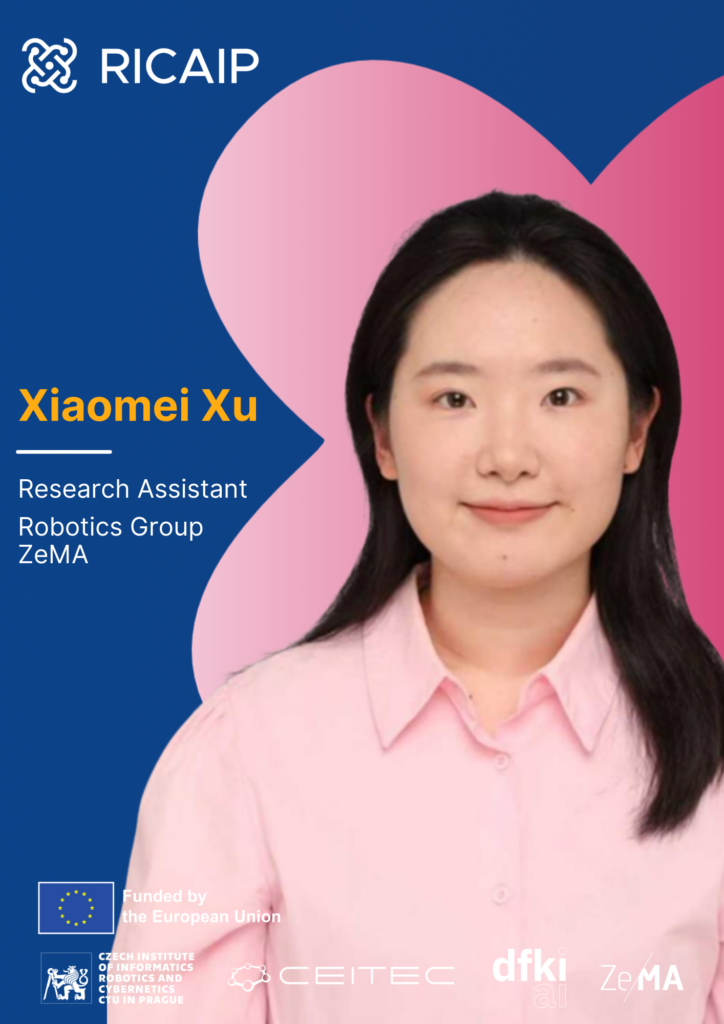
Xiaomei Xu
Research Assistant
Robotics group
ZeMA
Bio
I have been a research assistant in the Robotics group at the ZeMA Center for Mechatronics and Automation Technology since April 2020. I graduated with a master’s degree in automation technology from RWTH Aachen University in 2019, where I completed my master’s thesis on the iCellFactory project at the WZL Machine Tool Laboratory.
My specialization lies in developing adaptive frameworks for collision-free trajectory planning, using Siemens Robot Export and OMPL. During my internships, I worked at the Research Center Jülich and the VW Academy Hannover. Since April 2020, I’ve been involved in the Robotix Academy Project, where I’ve been developing an intelligent tangram puzzle system using industrial robots. Since July 2022, I’ve also been working on the RICAIP project, focusing on object recognition and 3D pose estimation for industrial parts in the Bin Picking challenge. Additionally, my research includes improving CAD reconstruction for precise product scans and developing robotic arms to sand burrs on ceramic products.
What part of your research do you currently find the most exciting or challenging?
Last year was intense. Between research challenges and conference goals, the workload made me question my long-term endurance.
At the IROS conference, a professor from King’s College London advised me to pursue what brings joy. Seeing fellow researchers light up while discussing robotics made me realize such intensity is common here. Now, I’m learning to prioritize, manage time, and balance life, work, and research.
What’s one skill or mindset your work in science has taught you?
I am a big math enthusiast. My work taught me to rely on hands-on experience. Through several industrial projects, I gradually accumulated the practical knowledge that led to breakthroughs in robotics.
I’m still learning. When formulas elude me, I turn to programming and simulation to grasp their meaning. It’s a slower, more methodical approach – but it works for me.
What advice do you wish you had heard at the start of your career?
Reflecting on my six-year PhD journey, I am deeply grateful. I was fortunate to learn mathematics from an inspiring mentor, receive patient guidance in publishing, and be supported from the very beginning by a professor who believed in me. Every day spent researching robotics brought genuine joy.
I am also thankful to my teammates, who generously shared the workload and complemented my skills in areas such as teaching and project management—strengths I did not always possess myself.
The advice I wished I was told is this: stay grateful, cherish the present, and choose kindness through every challenge. As Romain Rolland wrote, true heroism is “to see the world as it is, and to love it.”
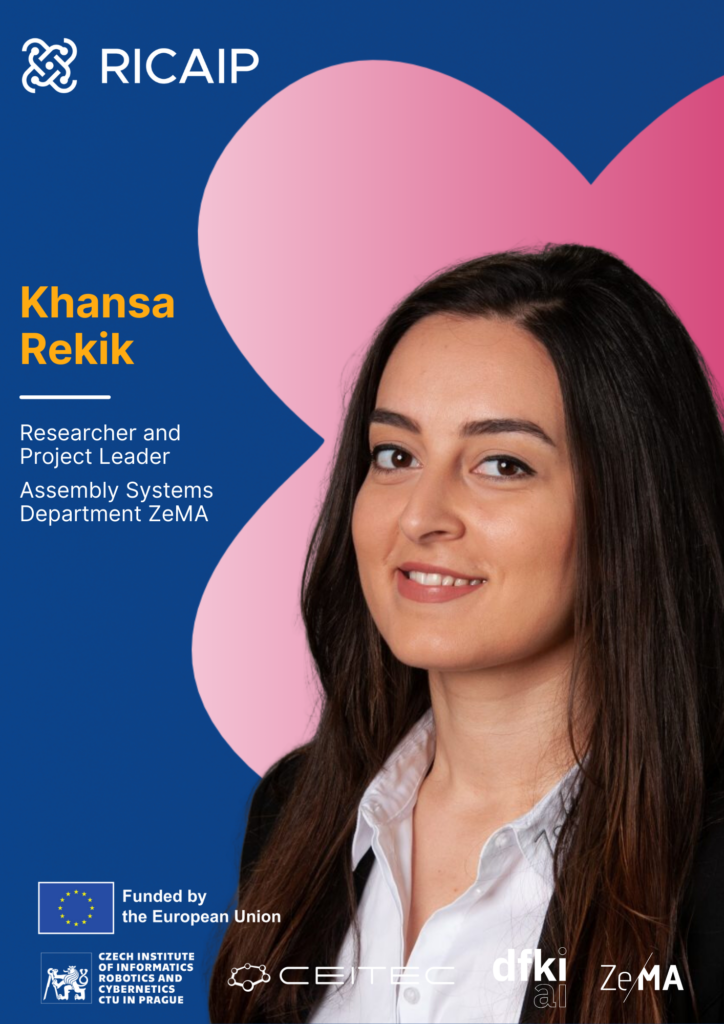
Khansa Rekik
Researcher and Project Leader
Assembly systems department
ZeMA
Bio
I am Khansa Rekik, a researcher and project leader at the Assembly systems department in ZeMA. Along with my current work at ZeMA, I am currently pursuing my PhD degree in the field of AI &Human-Robot collaboration. I have a masters degree in Industrial informatics and Robotics, and a master degree in Computer Science. During and after my studies I had the opportunity of working with international entities in research in France and Germany as well as in an multinational industrial manufacturing company.
What part of your research do you currently find the most exciting or challenging?
In my work on applied AI for industrial assembly systems, one of the key challenges is the rapid pace of AI development. A solution that is state of the art at the beginning of a project can quickly be overtaken by more efficient or capable approaches. This creates a constant tension between integrating emerging technologies and delivering robust, reliable systems. Determining when a solution is sufficiently mature for real-world deployment, rather than continually pursuing the latest advancement, remains one of the most difficult and important decisions in applied research.
What’s one skill or mindset your work in science has taught you?
My work has taught me to continuously question my own assumptions and to approach problems with practical judgment. Solutions that seem great in theory often reveal their limitations in real world environments, where reliability and usability matter more than complexity.
On a personal level, it has trained me to learn continuously and selectively, deciding what is worth mastering and what is sufficient to understand at a high level.
What advice do you wish you had heard at the start of your career?
That it’s okay to change direction without having a perfectly articulated long-term plan. Many of the most valuable opportunities in my career came from saying yes to projects that didn’t fit neatly into my original path but taught me how to think, collaborate, and adapt.
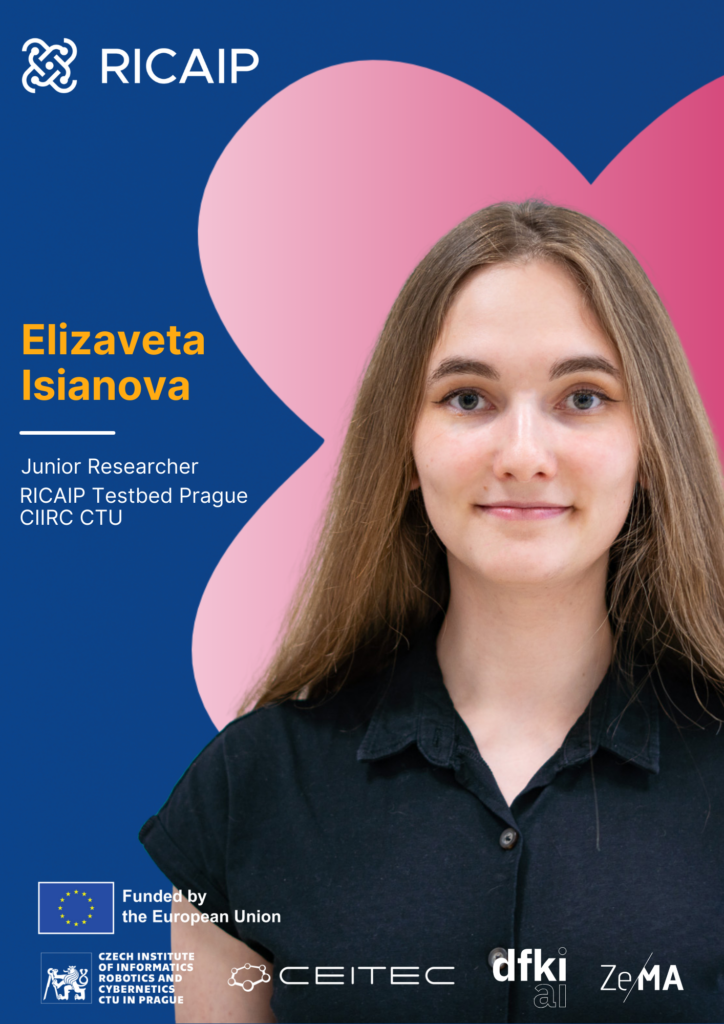
Elizaveta Isianova
Junior Researcher
RICAIP Testbed Prague
CIIRC CTU

Bio
I am a junior researcher at the Czech Institute of Informatics, Robotics, and Cybernetics at CTU in Prague (CIIRC CTU), where I work at the Testbed for Industry 4.0. I recently graduated with a Master’s degree in Robotics and Cybernetics from the Faculty of Electrical Engineering at CTU.
What advice do you wish you had heard at the start of your career?
I would advise my younger self to be brave enough to be bad at something new. One of the biggest obstacles, not just at the beginning of a career but throughout life, is the feeling that you are not good enough. It is important to realize that there will always be people smarter or more experienced than you, but that shouldn’t stop you. I’ve learned that hard work and persistence always pay off in the end.
What’s one skill or mindset your work in science has taught you?
Science, and especially robotics, has taught me that failure is not the end, but a necessary data point. When a robot crashes or code doesn’t work, it’s not a defeat, it is feedback. I’ve learned to embrace errors as a crucial part of the discovery process.
What part of your research do you currently find the most exciting or challenging?
The most challenging part is definitely the ‘reality gap’. Algorithms often work perfectly in simulation, but the real world is messy – lighting changes, sensors have noise, and physical interaction is not always predictable. Making a theoretical model work robustly on physical hardware is difficult, but bridging that gap is exactly what I find most rewarding.
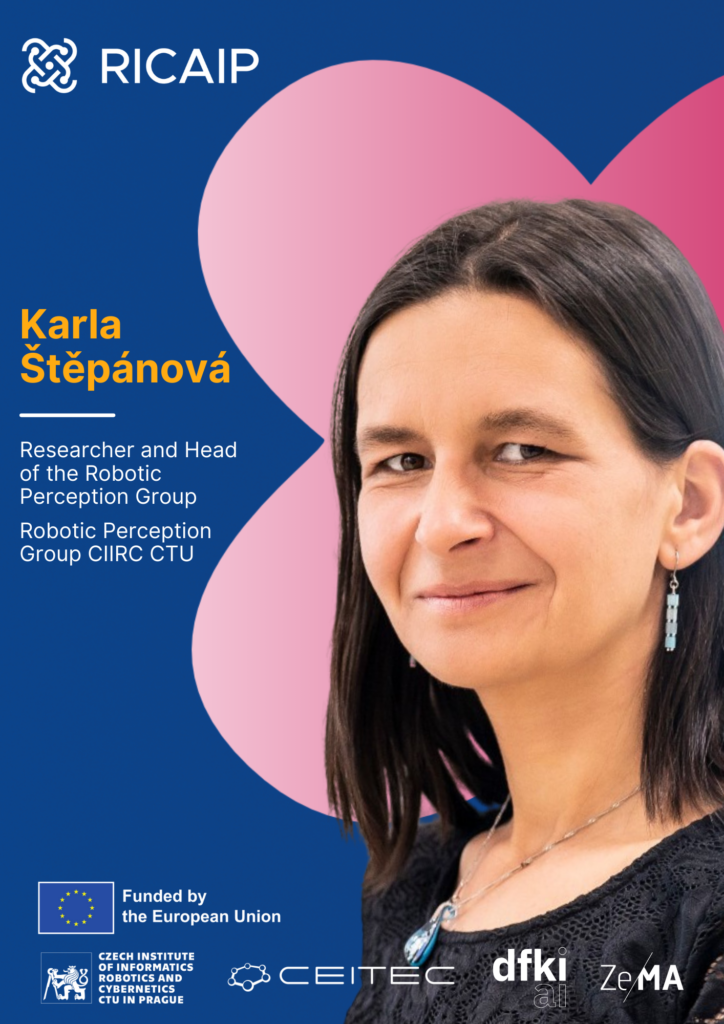
Karla Štěpánová
Researcher and Head
Robotic Perception Group
CIIRC CTU Prague
Bio
I am a researcher at the Czech Institute of Informatics, Robotics, and Cybernetics at CTU in Prague (CIIRC CTU) and the head of the Robotic Perception Group. My work focuses on developing AI-driven systems that enable robots to learn from human instructions and demonstrations. I am particularly interested in how robots can understand human intent and context by integrating data from multiple modalities using probabilistic models and multimodal neural networks.
I have been leading the Robotic Perception Group since 2024. I earned my Ph.D. in Artificial Intelligence and Biocybernetics from the Faculty of Electrical Engineering at CTU in Prague in 2017 and my Master’s degree in Condensed Matter Physics from the Faculty of Mathematics and Physics at Charles University in 2010.
My research interests include probabilistic models of cognition, unsupervised learning, multimodal integration, language acquisition, symbol grounding, learning by demonstration, and human-robot interaction.
What part of your research do you currently find the most exciting or challenging?
What excites me most is the chance to deeply focus on a research problem over a sustained period of time — breaking it down, understanding it thoroughly, and reaching that immersive state of concentration. I’m particularly enthusiastic about interactive task learning, where we combine knowledge extracted from observations with human knowledge and interpret both within context. Being trusted to work on this topic for five years through the Junior Star project is a unique and motivating opportunity.
The most challenging part is maintaining that long-term focus and protecting deep work time, while not getting pulled away by the constant stream of various tasks or diverging requests that can feel infinite. Another challenge is balancing basic research with applications. Translating research into practice is difficult but rewarding, yet truly novel research often requires stepping back and allowing others to focus on the application side.
What’s one skill or mindset your work in science has taught you?
Science has taught me that protecting research time is my own responsibility. After the PhD, no one will give you that time — you have to actively defend it and learn to say no. If you don’t, the quality of your results will suffer.
What advice do you wish you had heard at the start of your career?
I wish I had heard early on: focus deeply on one core problem or algorithm. Don’t try to build entire systems. Systems age quickly, but strong, well-defined algorithmic contributions can last and are way easier to present and publish.