
Humanoid robotics is gradually moving from research laboratories to its first pilot deployments in practice. Companies and public institutions are therefore seeking ways to safely test, evaluate, and responsibly implement these technologies. Responding to this demand, CIIRC CTU is establishing a new Interdisciplinary Center for Humanoid Robotics (ICHR). As a key partner, Alza is also joining the initiative, aiming to provide capacities for testing and making humanoid robots accessible to both companies and the education sector.
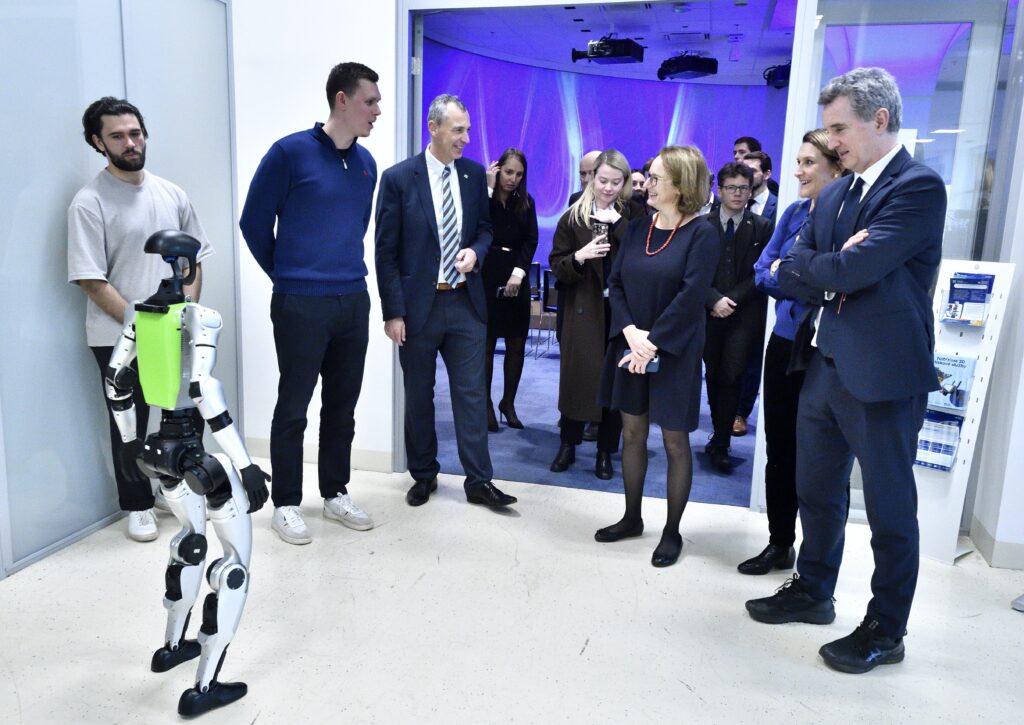
ICHR is a specialized platform of the Czech Institute of Informatics, Robotics and Cybernetics at CTU in Prague (CIIRC CTU), which connects technical research in humanoid robotics with issues of safety, practical use, societal acceptance, and responsible deployment. The center is built on interdisciplinary collaboration, bringing together experts in robotics, artificial intelligence, and cybernetics with specialists in ergonomics, interaction design for natural human-robot cooperation, law, ethics, and social sciences.
The establishment and direction of ICHR were also presented during a recent visit by representatives of the European Commission and the Ministry of Industry and Trade to CIIRC CTU, where discussions focused on industrial digitalization, practical impacts of AI, and translating research results into practice.
The “Royal Discipline” of Robotics Requires an Interdisciplinary Approach
According to the center’s founders Václav Kubáček, Tomáš Jochman, and Ondřej Švec from CIIRC CTU, humanoid robotics is the “royal discipline of robotics” – not only because of its technical complexity but also due to its impact on the workplace, safety, services, and daily life. Besides cutting-edge research, it also requires infrastructure for validation and testing. ICHR relies, among other things, on the RICAIP Testbed Prague research infrastructure, which allows solutions to be verified under conditions close to real-world operation.
“Humanoid robotics is no longer as inaccessible as it once was,” says Václav Kubáček, researcher at CIIRC CTU and one of the founders of ICHR. “Companies need verified procedures and safe frameworks for testing and implementing technologies. ICHR aims to be a place where research, industry, and societal context meet – and where results are translated into practice.”
Alza as a Partner for Making Robotics Accessible in Practice
ICHR’s partnership with industrial partners, especially Alza, strengthens the practical side of humanoid robotics development in the Czech Republic. Joint activities will include various forms of collaboration – from initial experiments and testing of specific scenarios to sharing experiences from pilot projects, education, and practical deployment. In recent months, Alza has expanded its robotics activities, focusing primarily on companies, research institutions, and schools that want to actively work with humanoid robots.
“Initial experiences show that interest in this technology is real. The first shipment of Unitree G1 humanoid robots sold out within six weeks without significant marketing support. Customers mainly use them as a platform for development, teaching, and experiments with autonomous systems and artificial intelligence,” says Alza PR Manager Eliška Čeřovská. She adds, “We see that customers today want hands-on experience, to understand the technology’s potential, and to start developing their own applications. This is exactly why collaboration with CIIRC CTU makes sense. We welcome ICHR as a previously missing platform that connects research, education, and real-world deployment.”
“The impulse for creating ICHR comes from the experience of our research teams, which have long focused on humanoid robotics from different perspectives and increasingly encounter specific demands for practical application. It is evident that a significant gap exists between current technologies and their safe deployment in real-world environments. We therefore see ICHR as a natural platform for knowledge sharing – not only toward the application sphere but also among research teams across disciplines, including students. At the same time, we aim to create an environment for safe testing and experimentation with the latest technologies,” says CIIRC CTU Scientific Director Prof. Vladimír Mařík.
Three Main Areas of ICHR Activity
ICHR is currently launching activities in three interconnected areas:
- Technological Challenges of Initial Deployment
- Integrating technical and societal perspectives
- Development and validation of new solutions and workflows
- Supporting companies and public institutions in pilot deployment
- Human-Centered Services and the Public Sector
- Platform for collaboration among industry, research, public administration, and society
- Decision-making based on expertise and verified data
- Emphasis on safe and responsible implementation
- Skills for Adoption
- Raising public awareness and clear communication
- Educational videos and practical guides
- Workshops, seminars, and sharing best practices
ICHR will gradually publish its outputs on the website ichr.cz and opens collaboration opportunities for additional companies, institutions, research teams, and students.